Maximo Application Suite Integration Architecture: A Practical Guide to API-First Connectivity
Modern Maximo Application Suite deployments demand a deliberate integration architecture. This article explains how to choose between MIF, OSLC, and the JSON API, design secure object structures, and size infrastructure for reliable, observable integrations.

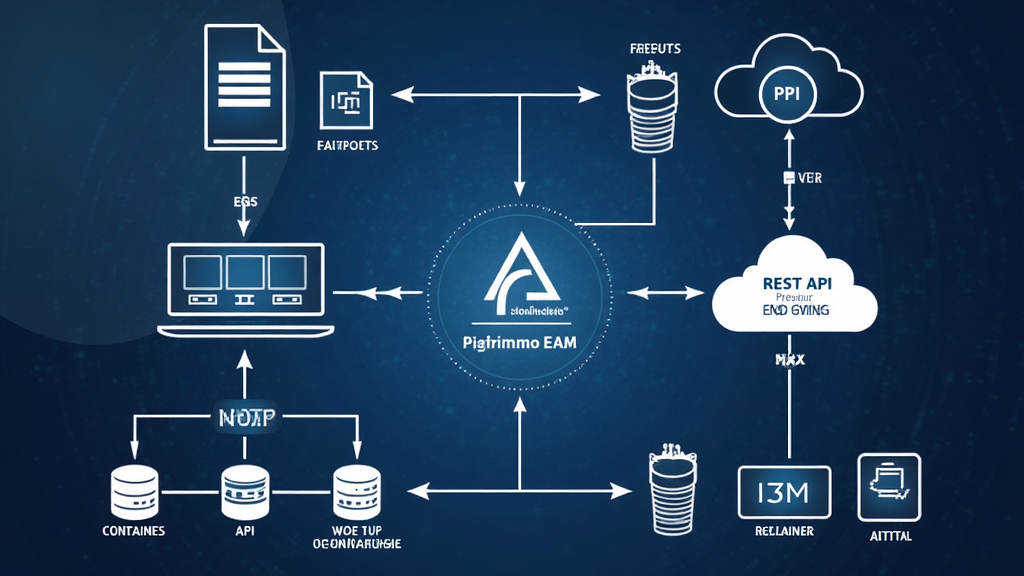
Maximo Application Suite Integration Architecture: A Practical Guide to API-First Connectivity
Enterprise asset management no longer lives in isolation. A Maximo Application Suite (MAS) deployment must talk to ERP systems, IoT platforms, mobile applications, GIS tools, SCADA historians, and reporting warehouses. Each connection adds latency, failure modes, and governance overhead. The difference between a brittle point-to-point mess and a maintainable integration fabric is architecture: the deliberate choices made about protocols, data contracts, authentication, and infrastructure before the first payload crosses the wire.
Integration in Maximo has evolved significantly. In older versions, the Integration Framework (MIF) supported flat files, XML over SOAP, and an early REST layer that exposed Maximo Business Objects (MBOs) directly. That legacy REST API still exists in MAS, but it is frozen in time. IBM's ongoing investment is in the JSON API built on top of the OSLC foundation. The new API powers the Maximo mobile application, the Next Generation user interface, and most modern integration patterns. Understanding when to use each option is not just a technical exercise; it affects security posture, upgrade paths, performance, and the ability of operations teams to debug failures at 2 a.m.
This article walks through the architectural layers that matter in a MAS integration program. We will cover the role of object structures as data contracts, compare MIF, OSLC, and JSON API usage patterns, review authentication and infrastructure considerations, and discuss observability. The goal is to give integration architects and platform engineers a decision framework they can apply immediately, whether they are connecting a single plant system or standardizing integration across a global fleet.
Why Integration Architecture Matters in MAS
A poorly planned integration strategy turns MAS into a traffic cop with no stoplights. Every external system requests its own data shape, its own credential, and its own retry logic. Eventually, the Maximo environment becomes a patchwork of enterprise services, publish channels, cron jobs, and undocumented scripts. Upgrade windows grow longer because no one knows which integration will break when a schema changes. Security audits become painful because API keys and service accounts are scattered across teams.
Good integration architecture starts with a contract-first mindset. Before writing the first line of code, the team documents what data each integration needs, how often it needs it, what success looks like, and what failure handling is required. This contract becomes the basis for object structure design, the selection of synchronous versus asynchronous patterns, and the placement of authentication boundaries. Without this discipline, the MAS cluster ends up carrying load it was never sized for, such as massive nightly batch extractions that could have been handled by a data warehouse.
Modern MAS runs on OpenShift or a supported Kubernetes platform. That changes how integrations should be thought about. Horizontal Pod Autoscaling (HPA), resource limits, and database latency all affect throughput. A synchronous REST call that works in development with ten records may time out in production with a million record result set because the API server pods are throttled or the DB2 database is waiting on disk. Architecture is where these constraints are addressed before they become production incidents.
The business value of clean integration architecture is easy to overlook until something breaks. When it works, asset data flows in from sensors, work orders update ERP finance modules, and mobile technicians see the same record the back office sees. When it fails, plants produce work orders from stale inventory data, compliance reports miss records, and maintenance windows are lost while teams manually reconcile systems. Treating integration as a first-class architecture concern protects uptime and makes the MAS platform easier to own over a multi-year lifecycle.
Object Structures: The Contract Layer
At the center of every MIF integration is an object structure. Think of it as the schema that defines what a Maximo record looks like to the outside world. An object structure combines one or more MBOs into a single logical payload. For example, a work order object structure might include the main work order record, its associated tasks, labor transactions, and material reservations. This grouping lets external systems receive or send complete business documents rather than isolated table rows.
Object structures are powerful because they abstract Maximo's physical table model. A downstream system does not need to know that work orders live in WONUM or that labor transactions are in LABTRANS. It consumes the object structure as a JSON document and maps its own fields accordingly. This abstraction is also where performance risk hides. If an object structure includes every attribute from every related table, a single query can pull thousands of fields and trigger deep database joins. The best practice is to start with a minimal object structure and add only the attributes the integration requires.
The IBM documentation recommends excluding nonpersistent attributes and avoiding oversized structures. A common mistake is to reuse the same object structure for a user interface report, a mobile sync, and an ERP batch. Each use case has different cardinality and field needs. A dedicated integration object structure usually performs better and is easier to change without breaking the UI. Naming conventions help here: prefixing integration-only object structures with INT_ or API_ makes their purpose obvious to future maintainers.
When building an object structure for the JSON API, remember that it is the contract that both sides must honor. The external system must provide required fields, and Maximo must validate business rules before persisting data. A missing required field such as SITEID on an asset will fail the entire payload, not just the bad record. Test object structures with representative data volumes and malformed records early in the design phase. Catching contract mismatches during testing is far cheaper than discovering them when a production ERP job throws a thousand-record exception at midnight.
A concrete production example is the design of a work order object structure for an ERP finance integration. The finance system only needs work order number, status, site, location, completion date, actual labor hours, and actual material costs. The first draft object structure included every attribute from the work order, its tasks, its labor transactions, and its material reservations. Load tests showed that a ten-thousand-record query took over ninety seconds. After trimming the object structure to twelve attributes, the same query completed in under ten seconds. The lesson: integration object structures should be designed for the caller, not for completeness.
MIF, OSLC, and JSON API: Choosing the Right Tool
Maximo offers several integration mechanisms, and the right choice depends on the use case, not personal preference. The Maximo Integration Framework is the umbrella term that covers flat files, database table interfaces, SOAP web services, REST, and OSLC. Within REST, there are really two APIs: the legacy /maxrest/rest API that exposes MBOs directly, and the OSLC-based API served from /oslc or /api that supports the modern JSON payload format.
The legacy REST API should generally be avoided for new work. It exists for backward compatibility but lacks the enhancements IBM continues to add to the JSON API. The newer API supports richer query capabilities, lean responses, action queries, and transformations. It is also the API used by the Maximo mobile application and the Next Generation desktop user interface, which means it receives more testing and feature development than the older layer.
OSLC and the JSON API share the same runtime foundation but differ in payload rules. OSLC follows a Linked Data standard with specific naming conventions and is useful when integrating with other OSLC-compliant tools. The JSON API is activated with the lean=1 query parameter and returns simplified JSON that most modern applications expect. Many practitioners use the term OSLC loosely to mean the modern API, but it is helpful to be precise. For new integrations, lean JSON is usually the better default unless the target system specifically requires OSLC semantics.
A simple decision matrix helps teams avoid religious wars. Use MIF with flat file or table interfaces for high-volume bulk loads that do not need real-time responses. Use the JSON API for synchronous web and mobile integrations where low latency and flexible queries matter. Reserve SOAP only when a legacy partner system requires it. Keep the legacy REST API on a deprecation path. Documenting this decision rationale in a short architecture note saves teams from revisiting the debate on every project.
The following table compares the main integration options by use case:
| Mechanism | Best For | Payload | Latency Expectation | Notes |
|---|---|---|---|---|
| MIF flat file / table interface | Bulk loads, nightly syncs | CSV, XML, database table | Minutes to hours | Good for high volume, low frequency |
| JSON API (lean) | Web, mobile, real-time queries | Simplified JSON | Sub-second to seconds | Preferred for new integrations |
| OSLC API | Linked-data integrations, OSLC partners | OSLC JSON | Sub-second to seconds | Use when OSLC semantics are required |
| SOAP / legacy REST | Backward compatibility only | XML or verbose JSON | Seconds | Avoid for new designs |
A real-world example is the integration between MAS and a logistics process management system in emergency response. The logistics system handles physical movement, while Maximo handles strategy and maintenance. The integration is bi-directional and near real-time. When an incident creates a demand signal, Maximo generates the work and asset requirement. The logistics system manages transport and chain of custody. When the asset returns, Maximo captures rehabilitation status. This kind of integration requires clear taxonomy alignment, robust error queues, and field-friendly mobile interfaces. It is a good illustration of how API-first design enables mission-critical workflows beyond the factory floor.
Authentication, Security, and Infrastructure Sizing
Authentication in MAS integrations has moved away from basic credentials and toward API keys. API keys are easier to rotate, easier to scope, and easier to audit than shared service accounts. They also reduce the blast radius if a credential is compromised. The IBM community guidance is clear: avoid hardcoding API keys in scripts, avoid sharing keys across environments, and restrict the privileges assigned to each key. A key that only needs to read work orders should not have write access to assets or locations.
Security is only one half of the equation. Infrastructure sizing determines whether the integration performs. A reasonable starting point for a MAS node is eight vCPUs, thirty-two gigabytes of RAM, and three hundred gigabytes of storage, but production workloads should be validated with load testing. More important than raw numbers are resource limits and autoscaling. OpenShift Horizontal Pod Autoscaling can add API server pods during peak load, and resource limits prevent a runaway batch job from starving other users. Database latency also matters: keeping DB2 read latency under two milliseconds makes a visible difference in API response times for object structures with multiple joins.
Automation scripts add flexibility but introduce risk. A Jython script attached to an integration event can transform data, validate rules, or call external services. A poorly optimized script can add forty percent or more to request latency under load. Scripts should be version controlled, tested with realistic volumes, and centralized for reuse. They should also include error handling that returns meaningful messages to the caller rather than silently swallowing failures.
A production example of infrastructure sizing comes from a MAS deployment supporting a global manufacturer. Initial load tests with five concurrent API clients showed acceptable response times, but a quarterly inventory sync job generated a thousand parallel requests and pushed API pods to their CPU limits. After enabling HPA and increasing the API server pod resource limits, the same job completed without timeouts. The team also added a circuit breaker in the calling ERP system so that temporary API slowdowns did not cascade into ERP failures. This combination of platform sizing and caller-side resilience made the integration stable under load.
Monitoring completes the picture. Enable MIF message tracking so that payloads, status codes, and errors are visible. Forward logs to an observability stack such as OpenShift Logging, ELK, or Instana. Set alerts for HTTP error rates, latency spikes, and queue depth on asynchronous channels. Integration problems rarely announce themselves during business hours. Good monitoring turns a weekend outage into a dashboard alert that someone can resolve before users notice.
Practical Implications
For most teams, the practical starting point is to catalog every existing Maximo integration before designing new ones. Map each interface to its protocol, object structure, calling system, data volume, and business owner. This inventory almost always reveals redundancies: two systems pulling the same asset data, or a nightly file that could be replaced with an event-driven API call. Consolidating these reduces load and simplifies maintenance.
Teams should also standardize on the JSON API for new integrations unless there is a specific reason to use MIF batch or SOAP. This aligns new work with IBM's roadmap and the mobile UI stack. At the same time, do not rewrite functioning MIF interfaces purely for the sake of modernization. The risk and cost rarely justify the change unless the existing interface is unstable or the business needs real-time behavior. A migration roadmap that moves interfaces as they are touched for other reasons is usually more sensible than a big-bang replacement.
Another practical step is to define retry and idempotency policies for every integration. A synchronous JSON API call that fails because of a temporary network issue should be retried with exponential backoff. A bulk load through MIF should be designed so that running it twice does not create duplicate records. Idempotency keys, stable identifiers, and upsert logic make integrations safer to rerun after failures. Without these policies, operations teams waste hours reconciling partial failures and cleaning up duplicate data.
Documentation also deserves attention. Each integration should have a short runbook that describes the business purpose, the protocol, the object structure, the expected data volume, the retry policy, the monitoring alerts, and the escalation path. This documentation does not have to be long. A single page is often enough. The goal is that someone who has never touched the integration can understand it and respond to a failure. In practice, most integration outages last longer than necessary because the only person who understood the interface has left the organization or is on vacation.
Finally, treat integration credentials and scripts as production artifacts. Store API keys in a secrets manager, keep automation scripts in a source repository with pull requests, and review object structures quarterly. The integrations that survive longest are the ones that are easy to understand, easy to test, and easy to hand off when the original developer moves on.
Bottom Line
Maximo Application Suite integration architecture is not about picking a favorite protocol. It is about matching each use case to the right mechanism, defining clear data contracts through object structures, securing credentials with API keys, and sizing infrastructure for real production load. The modern default is the JSON API on the OSLC foundation, with MIF batch reserved for bulk loads and legacy REST kept on a deprecation path. Invest in monitoring, script governance, retry policies, and load testing early, and MAS will remain a reliable hub rather than a fragile bridge between siloed systems.