The Maximo MCP Server: Why Model Context Protocol Changes the Integration Conversation
MAS 9.2 ships an MCP server for Maximo. Why Model Context Protocol is quietly reshaping the integration conversation for EAM teams.


The Maximo MCP Server: Why Model Context Protocol Changes the Integration Conversation
Every few years, something arrives in the Maximo ecosystem that quietly reshapes how integration teams work. The Maximo Integration Framework did it in the 7.x era when it standardized outbound messaging and object structures. REST APIs did it again when they made lightweight, point-to-point integrations viable without a middleware degree. And now, with MAS 9.2, IBM has shipped a Model Context Protocol (MCP) server for Maximo, and the integration conversation is shifting for a third time.
If you follow the agentic AI discussion coming out of MaximoWorld 2026 in Nashville, you have seen the demos: agents querying work order histories, drafting failure codes, even building Maximo features end to end. What most of those demos quietly depend on is the plumbing underneath, and in MAS 9.2 that plumbing increasingly speaks MCP. The protocol gives AI agents a standardized way to discover what Maximo exposes, call it safely, and return structured results. That sounds like a footnote. It is not. For integration teams, MCP is the difference between wiring an agent into Maximo by hand, object by object, and handing that agent a standard interface it can explore on its own.
This article is not another announcement recap. The community has made it clear, loudly, that announcement-level coverage is no longer enough. Practitioners want to know what a capability actually does in their landscape, what it replaces, what it breaks, and what they should do about it this quarter. So we will walk through what the MCP server genuinely is, how it relates to the Maximo Integration Framework and REST APIs you already run, what the agent integration pattern looks like in practice, and where the security and governance questions get uncomfortable. We will also look at the build-versus-buy question, because third-party platforms like interloc.ai are already selling on top of this layer, and by the end you should have a concrete adoption sequence you can bring to your integration team.
What the MCP Server Actually Is, and What It Is Not
Start with the protocol itself. Model Context Protocol is an open standard, originally introduced by Anthropic and now widely adopted across the AI tooling ecosystem, that defines how an AI application discovers and invokes capabilities exposed by a server. An MCP server publishes a list of tools, resources, and prompts. A client, which in practice means an AI agent or an agent-building framework, connects, reads the catalog, and invokes those tools through a consistent request-and-response pattern. The critical property is discoverability: the agent does not need a bespoke integration document to know what Maximo can do. It asks the server, and the server tells it.
That is what IBM shipped in MAS 9.2. The Maximo MCP server exposes Maximo business objects and operations as MCP tools, so an agent can list the available actions, understand their parameters, and call them. Read operations, such as fetching work orders, assets, or locations, map naturally. Write operations, such as creating or updating records, map too, and that is where both the power and the risk live, which we will come back to.
Now the corrections, because the hype cycle has already distorted this. First, the MCP server is not a replacement for the Maximo Integration Framework. The MIF remains the backbone for enterprise-grade, high-volume, transactional integrations with ERP systems, SCADA adjacencies, and anything that needs guaranteed delivery, transformation, and error handling. MCP does none of that. It is a conversational interface layer, optimized for agents that make many small, contextual calls, not for nightly syncs of half a million asset records.
Second, it is not a product that does anything by itself. An MCP server with no agent pointed at it is inert. Value only appears when you connect an agentic client that knows how to use the tools well, and the quality of that agent determines the quality of the outcome far more than the protocol does.
Third, it is not inherently an AI feature in the sense most people assume. Under the hood, the tools it exposes are the same kinds of Maximo operations your existing APIs already perform. What changes is who or what is calling them, and how they discover what is available. If you understand it that way, as a new facade over familiar capabilities, the integration work ahead becomes a lot less mysterious.
How MCP Slots Into the Existing Maximo Integration Stack
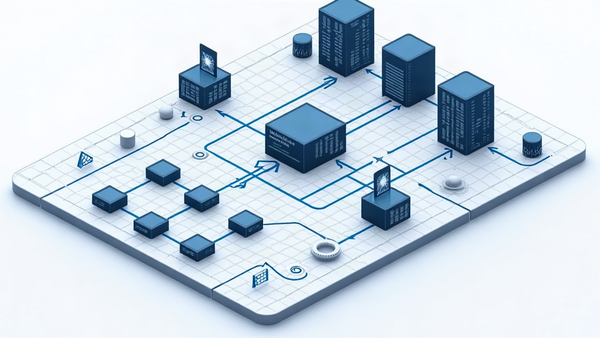
The mental model that works for most integration teams is layering. At the bottom sits the Maximo Integration Framework: object structures, channels, endpoints, and the machinery that has carried enterprise integrations for over a decade. Above it sit the REST APIs, which many organizations use for lightweight custom UIs, field tools, and point integrations. The MCP server sits on top of that stack as a new consumer-facing layer, designed specifically for AI agents.
Practically, this means the MCP server does not free you from thinking about your object structures. Whatever the MCP tools expose is derived from the same Maximo business objects and, in many configurations, the same object structure definitions you already maintain. If your GL configuration, site permissions, and object structure hygiene are messy, MCP does not hide that. It amplifies it, because now an agent can discover and call things you did not necessarily intend to be agent-accessible. Teams that invested in clean automation scripts and well-scoped object structures over the years will find MCP adoption straightforward. Teams with decade-old integrations held together with undocumented customization will find that MCP adoption becomes, unexpectedly, a data and configuration audit.
There is also the question of what you keep. Your middleware, whether that is an enterprise service bus, an iPaaS, or simple scheduled jobs, remains relevant for system-to-system traffic. The realistic end-state for most organizations is a dual-track integration landscape: MIF and middleware for deterministic, high-volume, contract-governed integrations, and MCP for agentic, human-in-the-loop, exploratory interactions. The mistake to avoid is treating these as competing standards. They solve different problems, and the organizations that get this right early will avoid an ugly retrofit later.
One more practical note: latency and call patterns. Traditional Maximo integrations batch and queue. Agents call frequently, in small units, often in tight loops while reasoning through a task. That is a different traffic profile than anything Maximo has historically served directly, and it is worth load-testing early rather than discovering the pattern in production. If your MAS deployment runs on managed infrastructure or a hyperscaler, confirm what the expected call volume profile looks like before an agent starts iterating against your work order API at machine speed.
The Agent Integration Pattern: Read, Write, and Guardrails
The agentic pattern that is emerging across the Maximo ecosystem follows a simple read-write split, and the guardrails you place around each half determine whether the pattern is safe.
On the read side, agents shine immediately. Give an agent MCP access to work order history, asset hierarchies, locations, failure codes, and inspection records, and it can do things that previously required a skilled planner with years of tribal knowledge: correlate a recurring failure across sites, summarize the last six interventions on a pump before a crew rolls out, draft a work order with the right failure class based on historical patterns. These read-heavy use cases carry low risk because the worst case is a wrong summary, and a human reviews the output before anything consequential happens. This is where most organizations should start, and where the fastest wins live. Several MaximoWorld 2026 sessions and community posts emphasized exactly this: the agents impressing people are the ones grounded in read access with human confirmation loops.
The write side is where discipline matters. An agent that can create work orders, adjust inventory, or modify asset records is genuinely useful, and also genuinely capable of doing damage at scale. The mitigations are not exotic; they are the same disciplines that governed MIF integrations for years, applied to a new caller. Scope the MCP tools the agent can see so it never discovers write operations it should not have. Run agents under dedicated Maximo user accounts with minimal permission sets, so the application's own security model enforces boundaries even if the agent misbehaves. Log every agent-initiated transaction with an identifier that ties it back to the agent session, so you can audit and, if necessary, unwind.
The most successful pattern reported in the community so far is human-in-the-loop writes: the agent prepares the transaction, a human approves it, and only then does the write execute. That preserves the speed benefit for the tedious part, drafting and gathering, while keeping a person on the commitment step. Fully autonomous writes are coming, and MAS 9.2's agentic workflow capabilities point there, but the organizations deploying today are almost universally keeping a human on the write path. Adopt the same posture until you have months of clean audit data saying otherwise.
Security and Governance Considerations
Any new interface into a system of record is an attack surface, and MCP deserves the same scrutiny your REST APIs and MIF endpoints received. The governance questions break into four groups.
Authentication and identity first. The MCP server should never be exposed anonymously, and agent connections should be tied to named, minimal-privilege Maximo identities rather than a shared service account. If your agent platform supports per-session credentials, use them. The principle is the one your security team already applies to every other integration endpoint: least privilege, unique identity, revocable access. The novelty of the protocol does not change the standard.
Data exposure second. An MCP catalog is, in effect, a machine-readable advertisement of what your Maximo can do. Make sure the tool list reflects what you are willing to expose. Organizations with multi-tenant or multi-site deployments should pay particular attention to site-level and organization-level scoping, because an agent operating across a broad tool set can traverse boundaries that a single-purpose integration never could. If you would not publish an operation to your integration partner network, do not expose it to agents either.
Audit and attribution third. Regulators, auditors, and internal reviewers will eventually ask who changed what and why. Agent-initiated changes need to be distinguishable from human-initiated ones. Ensure agent sessions carry identifiable credentials, enable Maximo's tracking and audit features for the objects agents touch, and retain logs at a depth that supports reconstruction of an agent's decision trail. The teams that set this up on day one will have a far easier time expanding agent permissions later than the teams that bolt it on after an incident.
Finally, vendor and third-party governance. The agentic ecosystem around Maximo is growing quickly, and third-party platforms such as interloc.ai are positioning themselves as agentic layers on top of Maximo data. Evaluate them the way you would any integration vendor: what credentials do they hold, what data leaves your environment, what is logged, and who is contractually responsible when an agent makes an expensive mistake. Enthusiasm for the technology is not a substitute for a security review, and your integration governance board should treat agent platforms as first-class integration citizens, with all the obligations that implies.
Build Versus Buy: MCP, Custom Agents, and the Emerging Platform Layer
Once you accept that MCP is the interface layer, the next decision is who builds the agents that use it. There are three realistic paths, and most organizations will blend them.
The first path is IBM-native. MAS 9.2's agentic capabilities let you configure agent workflows inside the platform, and IBM's demonstrations, including the widely shared story of an AI agent building a Maximo feature end to end, show how far the platform tooling can go. For organizations already committed to the MAS roadmap, staying inside the IBM stack minimizes integration surface and keeps support relationships clean. The trade-off is flexibility: you build within the patterns IBM provides, and highly custom agentic behavior may require more configuration effort than a purpose-built framework would need.
The second path is custom agents on open frameworks. If your organization has an AI engineering team, connecting an agent framework to the Maximo MCP server directly is now a reasonable project. You get full control over behavior, prompts, and guardrails, and your team builds durable skills in a fast-moving area. The trade-off is ownership: you maintain the agent, handle its failures, and absorb the pace of change in both the agent framework and the Maximo tool surface. This path suits organizations where agentic capability is strategically important, not just operationally convenient.
The third path is the vendor layer. Dedicated platforms are arriving specifically to sit between Maximo and enterprise AI agents, handling the connection, guardrails, and use-case templates so EAM teams do not have to become AI engineering shops. This is attractive for organizations that want outcomes this quarter without hiring. The trade-off is dependence on a young ecosystem and the governance scrutiny described earlier.
A practical filter for choosing: if the use case is generic, such as work order summarization or planner assistance, buy or configure. If the use case encodes competitive or operational secrets specific to how your organization runs maintenance, build. And in every case, insist that whatever you deploy speaks MCP against your own MAS 9.2 instance, so you are not locked into a proprietary connection layer that could strand you in a future migration.
A Practical Adoption Sequence for Integration Teams
If you are an integration lead wondering where to start, here is a sequence that reflects what is working in the community right now.
Weeks one and two: inventory and exposure review. Audit your object structures, automation scripts, and security groups with an eye toward what the MCP server will expose. Identify the objects that are safe for read access, the ones that need scoping, and the ones that should never appear in an agent catalog. This is configuration hygiene work that pays off regardless of your agentic ambitions.
Weeks three and four: read-only pilot. Connect a single agent, under a dedicated minimal-privilege account, to read access on work orders and assets. Pick one high-friction planner or supervisor workflow, such as pre-job history briefing, and measure whether the agent actually saves time. Keep the pilot narrow and the success criteria concrete.
Months two and three: human-approved writes. If the read pilot earned trust, extend to write operations with mandatory human approval. Instrument everything: audit logging, agent session attribution, and a rollback procedure. Expand to one additional use case only after the first one has run cleanly for a month.
Quarter two: platform decision. With real usage data in hand, decide your long-term posture across the build-buy blend, negotiate vendor terms if buying, and formalize your agent governance policy so the next proposal lands on established rules instead of a blank page.
Practical Implications
For integration teams, the arrival of MCP is genuinely good news wrapped in real work. The good news: a standard, discoverable interface means the era of hand-rolling every agent-to-Maximo connection is over, and the skills you already have in object structures and security groups transfer directly. The work: MCP adoption is an exposure review, a security exercise, and a governance project as much as it is a technical enablement. Treat the tool catalog as a published API surface, scope it deliberately, and put agents under the same identity, audit, and least-privilege regimes as every other integration consumer. Start with read-only use cases where a wrong answer costs a little embarrassment rather than an inventory error, and hold the human-approval line on writes until your audit trail earns you the right to relax it. Teams that sequence it this way will be running useful agentic workflows inside MAS 9.2 within a quarter, while teams that skip the governance step will spend that same quarter explaining an incident.
Bottom Line
The Maximo MCP server is not a replacement for anything you run today. It is a new layer on top of the Maximo Integration Framework and REST APIs, purpose-built for AI agents, and it is the connective tissue that makes MAS 9.2's agentic capabilities real rather than demo-ware. The strategic read is simple: agents are becoming a permanent consumer of Maximo, and MCP is the contract they will use. Integration teams that treat this as their newest integration endpoint, governed with the same rigor as every endpoint before it, will convert the agentic wave into measurable planner and supervisor productivity. Teams that either ignore it or expose it casually will spend the next two years cleaning up the consequences of that choice. The interface standard has arrived. What you do with your side of it is the actual decision.